Airflow Test


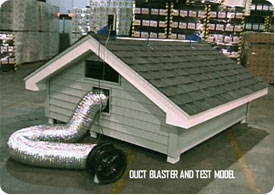
All tests were performed on a hermetically sealed test model, according to the specifications of the test equipment. Each vent was mounted over a 91” long by 2” wide exhaust slot on the ridge of the roof model, and sealed top and bottom (closed cell foam strip) so the airflow measured was through the ventilation openings in each test vent.

The Duct Blaster test components meet the flow calibration specifications of both the CGSB Standard 149.10-M86 and ASTM Standard E779-87. The Minneapolis Duct Blaster has a fan flow accuracy of +/- 3 percent using the Energy Conservatory Digital Manometer (DG-3).

Note: The 5 pascal pressure utilized was chosen because it is one of  the smallest units of pressure that is commonly used for airflow / pressure measurements. As an example, 5 Pascals = 0.0014765 inches of mercury, or 0.000725 pounds per square inch of air pressure. This is similar to the low wind speed and pressure typically found in an attic roof cavity on a calm day.
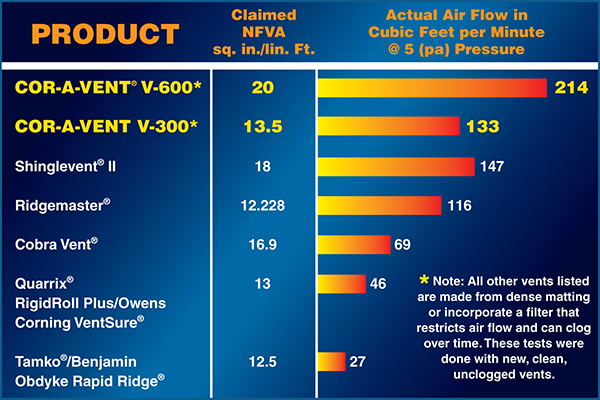


Note: these tests, measurements, and calculations were performed using the Energy Conservatory Minneapolis Duct Blaster (Series B) fan assembly, in conjunction with the Minneapolis pressure and fan flow gauge (Digital Manometer Model DG-3).


Blog

Latest Blog Posts


You can email orders to us now:

orders@cor-a-vent.com 


Revolution used for Joplin, MO project

Cor-A-Vent recently donated Revolution Rolled Ridge Vent to the Tulsa, OK Habitat for Humanity to be used in their re-build project in Joplin, MO to help re-build that community in the wake of the devastating May 22 tornado. You can read about the Ten for Joplin project here: http://www.tenforjoplin.org/


(Habitat-Tulsa press release) JOPLIN, Mo. – Sept. 8, 2011 – The Tulsa and Joplin Area Habitat for Humanity teams, surrounding businesses and the City of Joplin are partnering on one of the most aggressive rebuilding efforts since last May’s devastating EF-5 tornado. The Ten for Joplin project team plans to build 10 homes during a 16-day period for low-income families in Joplin by Thanksgiving.

Community leaders announced the project at a news conference on the site of one of the new homes. The build is scheduled between Oct. 29 and Nov. 13 and will be take place in a neighborhood of Joplin that was in the affected area.

As the citizens of Joplin move into the rebuilding phase of their recovery, the need to help those who lost their homes has become evident. Of the nearly 7,500 homes damaged, some 43 percent were uninsured.

Ten for Joplin’s vision is to ignite volunteer efforts to rebuild Joplin by setting an example of what can be accomplished when businesses and communities come together to help one another.

“This is an exciting partnership that will not only provide 10 homes for 10 families, but will demonstrate the many benefits communities gain when working together,” said Joplin City Manager Mark Rohr. “As part of the Midwest, Tulsa Habitat and all of their volunteers and sponsors recognize the powerful reward one gets when helping their fellow neighbor.”

Donations and volunteers are needed to make this project a reality. The goal is to raise $800,000 in funds plus gifts in-kind and get 3,000 volunteers to support us on the blitz build. To date, Ten for Joplin has secured $400,000 toward this goal.

Companies that have signed up to be house sponsors are Hilti, Henry & Anne Zarrow Foundation, BKD CPAs & Advisors, Samson, TD Williamson, Inc. and Chase. Advanced Industrial Devices, Inc. also has signed up to sponsor half a house. Gift in-kind donations have been provided by Hilti, Thermal Windows, Inc. and Cor-A-Vent. United Way contributed tornado relief funds to help with the purchase of the ten lots.